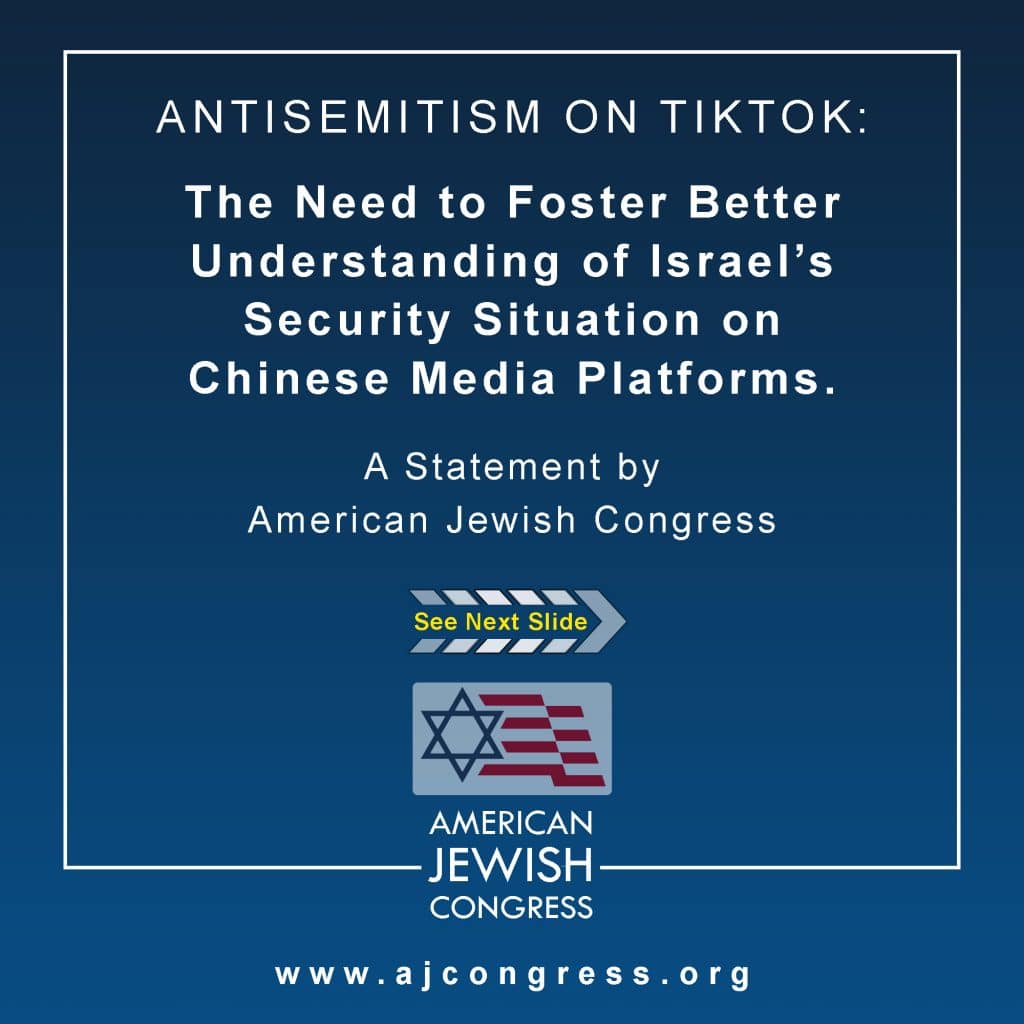

New York, NY, November 24, 2023 – TikTok is teeming with antisemitic and anti-Jewish content. The platform came out this week to defend itself against accusations that it is exploiting the war Hamas launched against Israel on Oct. 7 to manipulate young users in the United States to promote content that favors Hamas terror organization. While this is limited to TikTok, a research group at Tel Aviv University in Israel has identified a larger trend where China-based or linked institutions, individuals and platforms appear to be turning anti-Israel and sometimes dehumanizing Jews. Many in Washington and Jerusalem are taking notice. We believe so should officials in Beijing, especially when the matter goes beyond demonizing Israel to pushing the talking points of a terror group. Recent improvements in U.S.-China ties provides an opportunity for all sides to talk about this issue and act.
Some signs of concern:
- The Arabic broadcast of Chinese state media outlet CGTN is giving Middle East viewers a biased coverage that portrays Israel’s war against Hamas as a war on Palestinians. CGTN-Arabic anchors use the term ‘Israel-Palestine war’ that legitimizes Hamas.
- An activist in the U.S. linked to harassing American Jews in the Boston Mapping Project case, and is one of three anti-Israel activists arrested by American law enforcement for allegedly setting fire to a facility in New Hampshire owned by an Israeli company, has been featured on CGTN defending TikTok.
- Research released by the Institute for National Security Studies (INSS) at Israel’s Tel Aviv University says antisemitism “has exploded on China’s social media and traditional media, spouted by Communist Party media outlets, senior researchers, and diplomats.”
- Interestingly, online digital maps from Chinese outlets Baidu and Alibaba have removed all references to Israel as conflict rages in Gaza.
TikTok responded to this criticism this week by saying its algorithm does not deliberately amplify antisemitic and pro-Hamas content and justified the wide circulation of this content on TikTok by saying it is popular among young users in the Middle East and America. TikTok’s statement comes with supporting social media statistics. But the fact is that antisemitic and pro-Hamas content is out of control on TikTok when any content related to Uyghurs, for example, is suppressed.
TikTok’s detailed statement shows the Chinese company wants to be responsive to American concerns. But taken together with Israeli think tank INSS’ findings on alleged demonization of Israel on media platforms in China, this matter assumes another dimension. American, Israeli, and Chinese officials, civil society organizations, and the media can and must work together and find ways to foster better understanding in Chinese media of Israel’s national security situation.