A Defining Test For Iran’s Regime: What Muscat Talks Reveal About This Moment
What’s Happening
- U.S.–Iran talks are set for Friday morning in Muscat, Oman, amid nationwide protests, internet shutdowns, fresh Western sanctions, and a visible U.S. military buildup.
- Some analysts view the talks as a high-stakes test of whether Tehran will comply with U.S., Israeli, and Arab demands, or further isolate itself.
- Even before talks begin, U.S. diplomacy has exposed Tehran’s discomfort with transparency: Iran rejected participation if Arab and Muslim partners were present, demanded the venue shift from Turkey to Oman, and insisted that only American and Iranian negotiators can attend.
- The episode underscored a key reality: Iran’s regime does not trust its own neighbors, even those trying to help avert escalation.
The Unfolding Drama
Many news outlets are reporting that everything is not normal behind the scenes. Here’s how the Guardian of the U.K. framed it:
- U.S.–Iran talks scheduled for Friday were nearly cancelled after Washington rejected Iran’s demand to move talks from Turkey to Oman without neighbors’ participation.
- Arab and Muslim states intervened at the last minute, urging the White House not to walk away; talks were salvaged and moved to Muscat, Oman.
- Talks are occurring amid a major U.S. naval and airpower buildup, widely framed as a final off-ramp before possible U.S. military action.
- Iran insists talks be limited strictly to the nuclear file; the U.S. demands missiles, terrorism sponsorship, and human rights also be addressed.
American Signaling
- President Donald Trump explicitly warned that Supreme Leader Khamenei “should be very worried.”
- Vice President J.D. Vance said in a podcast on Thursday on Iran’s nuclear ambitions: “Iran cannot have a nuclear weapon. That’s the stated policy goal of the President…We know the history. The President has no interest in repeating the history of Iraq, but you don’t let crazy people get nuclear weapons.”
- Secretary of State Marco Rubio told the Senate Foreign Relations Committee that the radical Islamist regime in Iran is “probably weaker than it has ever been.”
- Rubio tweeted later that the Iranian regime does not reflect the people of Iran, echoing remarks he delivered at his confirmation hearing a year ago, when he said a radical Shia Muslim regime should not govern civilized Persians in Iran.
- The U.S. position, articulated by Rubio, is that meaningful talks must eventually include Ballistic missiles, terror sponsorship, nuclear program, and treatment of Iran’s own people.
- Treasury Secretary Scott Bessent told the Senate Banking Committee on Thursday that Iranian leaders are moving money out of the country “like crazy,” which he views as a sign that “the end may be near” for the current regime.
- On Thursday, trolling the regime, CENTCOM’s account on X posted a video clip of the activity aboard USS Abraham Lincoln, which is thought to be on standby in the waters close to Iran.
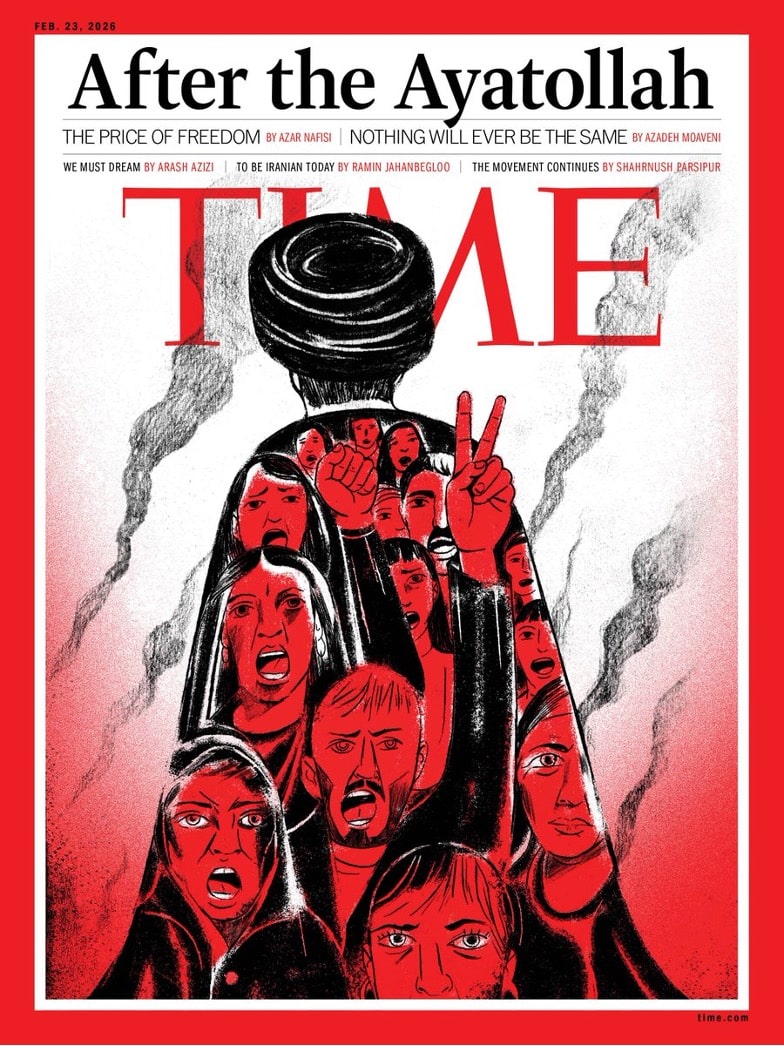
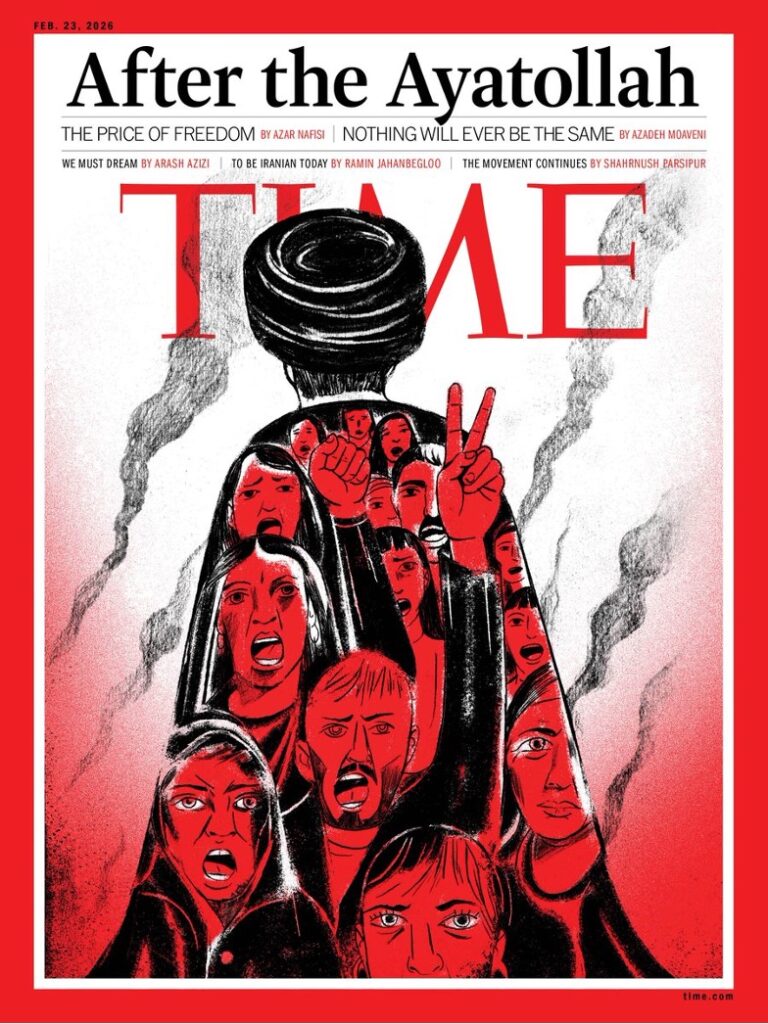
- Time magazine’s new cover is Iran’s despot Khamenei draped in the blood of his people:
Iranian Signaling
- Mohammad Marandi, a former adviser to Iran’s nuclear negotiating team and son of Iran’ despot Khamenei’s personal doctor, threatened on Thursday all countries hosting U.S. military bases in the Middle East, in a chilling one-line message on X: “It’s time to immediately leave all countries that host US bases in the Persian Gulf region.”
- Iran’s military issued a statement warning that in case of an attack it will strike American interests in a region extending from “occupied territories to Gulf waters,” a reference to Israel and Gulf Arab states.
- An Iranian propaganda TV station based in Lebanon claimed victory ahead of the talks, boasting Iran had forced Washington to “return” negotiations “to their proper track,” referring to the move from Turkey to Oman and the exclusion of Arab and Muslim neighbors invited by the U.S. to watch Iran give concessions in the meeting.
The same Iranian outlet in Lebanon ran a segment that discussed the futility of a possible U.S. ground invasion of Iran, even though Washington has not discussed any such plans. This shows the level of alarm on the Iranian side.
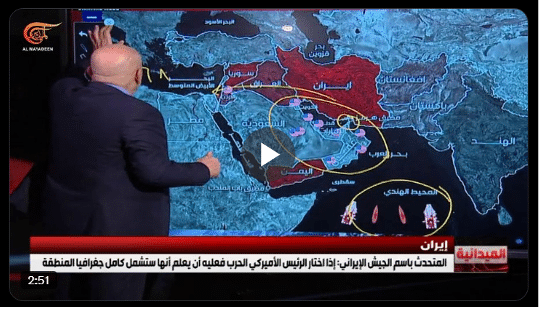
Iran’s Al-Mayadeen TV outlet that broadcasts in Arabic from Lebanon discussed a possible ground invasion of Iran, showing the level of alarm in Iranian circles at U.S. military deployments in the region.
Iranian Opposition
- Iran’s exiled crown prince Reza Pahlavi is framing this moment as a push toward a post-Islamic Republic relationship with the West. He’s renamed the protests inside Iran as the “Lion and Sun Revolution,” a reference to Iran’s original national flag before the ayatollahs seized power. Iranians worldwide quickly launched the hashtag #LionAndSunRevolution on social media.
Our Core Takeaway
- Negotiations must not become a pressure release valve for a regime losing legitimacy.
- Any diplomacy that ignores the Iranian people risks prolonging repression and terror financing.