Khurshid Kasuri offers rare insight into U.S.–Iran diplomacy, Pakistan’s role, and Iran’s negotiating posture
- This was the first time a former Pakistani Foreign Minister has briefed an American Jewish organization
New York—A former Pakistani foreign minister who played a covert role in relaying messages between the United States and Iran years ago says Israel is now indirectly represented in the talks in Islamabad brokered by Pakistan.
Khurshid Kasuri, Pakistan’s foreign minister between 2002 and 2007, helped Washington and Tehran quietly discuss Iran’s problematic nuclear program. Leaked diplomatic cables in 2011 show that Kasuri’s boss at the time, then Pakistani President Musharraf, a U.S. ally, wanted Iran to give up its nuclear program.
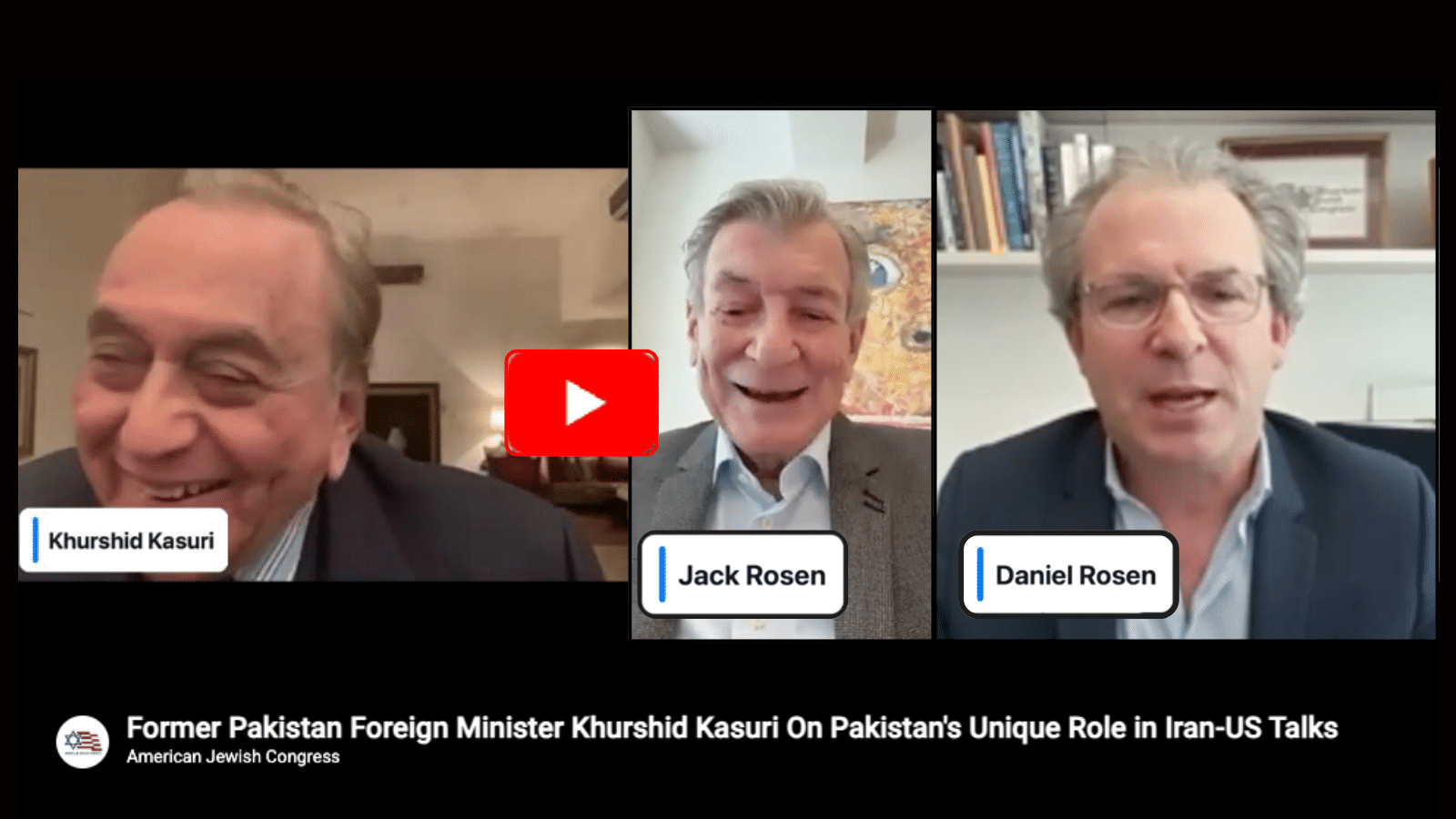
Kasuri spoke with American Jewish Congress President Daniel Rosen and Chairman Jack Rosen on April 21 in a Special Briefing on the U.S.-Iran Talks in Islamabad. This was the first time that a former Pakistani foreign minister briefed an American Jewish organization. And, in Kasuri’s case, someone with experience working directly with the United States, Israel, and Iran.
Opening the briefing, American Jewish Congress President Daniel Rosen pointed to the organization’s decades-long engagement across the Middle East and South Asia—including early outreach in the Gulf and efforts to connect regional actors—as the basis for understanding how diplomacy in this region operates. He emphasized that such diplomacy is often conducted quietly and through intermediaries, offering context to Pakistan’s U.S.-backed current role in Iran.
Jack Rosen, Chairman of the American Jewish Congress, reconnected with Minister Kasuri after twenty years. In 2005, both Jack Rosen and Kasuri shared a significant diplomatic moment in the region when the AJCongress secured a breakthrough in Israel-Pakistan bilateral relations.
ISRAEL’S PRESENCE IN IRAN TALKS
Former Minister Kasuri said Israel is involved in the Pakistani mediation through the United States, and that its interests are being watched by Washington. He said he was not being flippant when he said the United States would not do anything that endangered Israel’s security. His formulation was that Israel is “represented in every way” through the American side, even if it is not physically at the table in the Pakistani capital. There have been voices inside Pakistan recently that suggested Pakistan could consider a role for Israel at the table with Iran, seizing this opportunity to expand future bilateral prospects between Islamabad and Jerusalem. We at the American Jewish Congress weighed in on that debate at the time, as part of our outreach in that region.
Kasuri suggested that during his time, when the issue of Iran’s terror proxies that target the United States, Israel, and Arab partners was raised, the regime in Iran called these militias tools in its “forward defense” strategy.
In his view, there are people in Iran who do want to talk to the United States, including less radical elements, and Pakistan has been in contact with them.
PERSONALLY INVOLVED IN MESSAGE EXCHANGE
Kasuri said this is not a new role for Pakistan. He recalled that Pakistan had previously passed messages between the United States and Iran, and that he himself had been involved in such exchanges. Pakistan is a Cold War American ally that helped Dr. Henry Kissinger secretly pass through the Pakistani capital to China in 1972 to open diplomatic relations with that nation, he said, recalling a long history of American-Pakistani diplomatic ventures like what is being attempted today with Iran. His bottom line: Iran would like to come to the talks, but internal divisions in Tehran and what the Iranians see as inflammatory public messaging from Washington may have made that harder.
ARAB GULF ROLE IN IRAN TALKS
Kasuri offered interesting context about Gulf Arab grievances and whether they are represented in the U.S-Iran talks in Islamabad, arguing that Pakistan would ensure that Arab grievances were on the table in Islamabad for the Iranians to address. He said Pakistan cannot ignore Gulf concerns because millions of Pakistanis work in Gulf states and their remittances are vital to Pakistan’s economy. He described instability in the Gulf as a direct nightmare scenario for Pakistan, warning that if the Gulf economies are badly shaken, Pakistan would suffer serious consequences.
POTENTIAL CHANGE IN IRANIAN BEHAVIOR
Kasuri took questions from AJCongress briefing moderators on whether the Iranian regime’s behavior has changed since he dealt with them as foreign minister. Kasuri said that even in his time, senior Iranian officials were willing to explore formulas they believed might be acceptable to Washington. He cited long conversations in Islamabad with Iranian national security advisor Ali Larijani and former Foreign Minister Kamal Kharrazi, both eliminated in conflict in recent weeks, aimed at drafting language that could help move things forward.
He said the United States at that time was not interested in engaging along those lines, but in his view, the Iranians did want to negotiate and felt it was in their interest to normalize relations with the United States. He added that before the recent war, many people in the region believed there was significant pro-American sentiment inside Iran among people unhappy with the regime. His caveat was that he does not know how much the recent war may have changed that mood. Statements that may sound like posturing in Washington, he said, do not sound like posturing in Iran. He argued that Iran has every reason to want sanctions relief and to become a “normal country,” given its size, resources, and economic potential. But the dilemma, as he framed it, is that the entrenched regime does not want change if that change comes at its own expense.
His overall view: Iran wanted to negotiate then, and he believes it wants to negotiate now as well.
WILL IRAN CONCEDE GROUND FOR TALKS TO SUCCEED?
Kasuri addressed the point of whether Iran is ready to make real concessions on its nuclear program, missiles, and proxies. He approached this by asking the audience to put themselves in Iran’s position. If other states in the region have nuclear powers, missiles, and major American weapons backing them, he argued, why would Iran easily give up what it sees as its defenses? It makes little sense, he said, to expect Iran to compromise on core deterrent capabilities unless there is a broader regional peace arrangement.
On missiles, he offered a diplomat’s solution to a serious military threat, suggesting that meaningful limits are only realistic – in diplomatic terms – if they are part of a wider framework applying to all states in the region, not Iran alone. He was skeptical that Iran would agree on the nuclear file in the way Washington and others may want. He said Iran may be prepared to make some compromises, but noted that what others call “proxies,” Tehran sees as “forward defense.” His bottom line was that some things can be negotiated, but not in isolation; the hardest issues would require a broader regional security settlement, if things were left to diplomats to decide.
A REGIME IN TROUBLE FROM WITHIN
The former Pakistani foreign minister acknowledged internal Iranian opposition and pressure on the regime and said there is no doubt that opposition to the regime exists inside Iran, though he would not quantify it. He said this is not new and referred to a longstanding view, heard even before the recent war, that many Iranians were deeply unhappy with the regime and, in some cases, even relatively pro-American. But he cautioned that bombing and statements about ending Iranian civilization may have rallied some Iranians around the regime, though he could not say how durable that rallying effect would be, he added. His formulation was careful: he did not deny that real opposition exists but said the current balance inside Iran is hard to judge.
CONDEMNING OCTOBER 7; DISCUSSING THE ABRAHAM ACCORDS
Former Foreign Minister Kasuri, responding to questions from an international audience that joined the briefing from the United States, Israel, the Middle East, and Pakistan, condemned the October 7 attack on Israel and the murder of innocent civilians. He said the constant stream of images of civilian deaths in Gaza disturbed the Arab-Muslim populations and impacted potential progress in expanding the Abraham Accords.
But he suggested politics, and not culture or religion, were standing in the way of expanding the Accords. He made an endearing reference to the children of Abraham and said blessing Abraham’s progeny was a mandatory component of daily Muslim prayer, arguing that, unlike medieval European antisemitism, Arab-Muslim medieval literature did not mobilize anti-Jewish sentiments, implying that modern politics were responsible for the rupture between the Jewish and Muslims worlds.
Watch Former Foreign Minister Kasuri’s Special Briefing on YouTube At This Link